Minimum
30 m net head
50–300 m preferred. Below 30 m the economics stop working with this machine.
Engineering
Internals, specifications, site requirements and economics, from whitepaper v3.7. Every figure is an estimate.
The unit
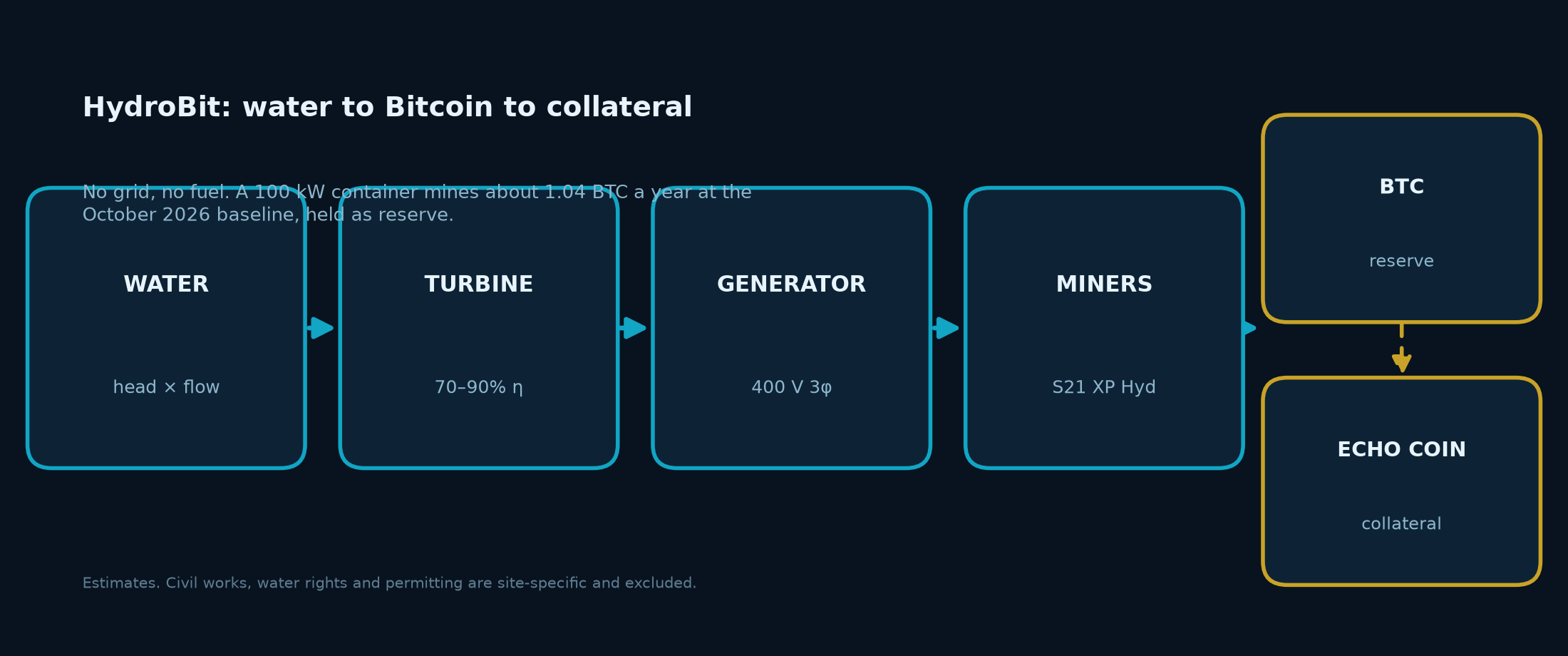
A standard ISO container, integrated and factory-tested, that arrives complete. The containerized hydro plant is not a new idea — what is unbuilt is putting the mining load, its cooling and the satellite link inside the same box.
Scale economics
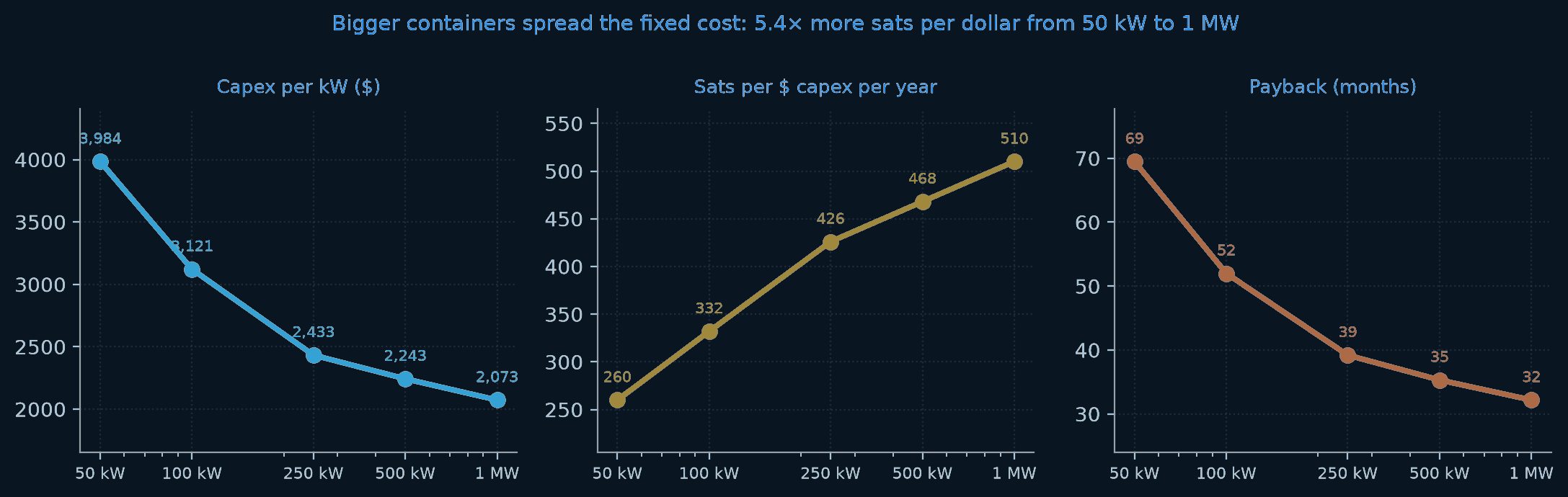
Controls, safety and integration cost roughly the same on every box. Spreading them over more kilowatts cuts capex per kW from $3,984 at 50 kW to $2,073 at 1 MW, and raises the Bitcoin captured per dollar of capex from 260 to 510 sats a year.
| Container | Mining load | Gross / month | Capex | Per kW | Paybackflat difficulty | Sats / $ / yrpre-halving | Payback2028 halving at mo. 18 |
|---|---|---|---|---|---|---|---|
| 50 kW · 20 ft | 45 kW | $3,489 | $199,180 | $3,984 | 69 mo | 260 | 120 mo |
| 100 kW · 20 ft | 91 kW | $6,978 | $312,110 | $3,121 | 52 mo | 332 | 86 mo |
| 250 kW · 40 ft | 227 kW | $17,445 | $608,350 | $2,433 | 39 mo | 426 | 60 mo |
| 500 kW · 40 ft | 460 kW | $35,326 | $1,121,420 | $2,243 | 35 mo | 468 | 52 mo |
| 1 MW · 15 ft + 20 ft | 925 kW | $71,088 | $2,072,820 | $2,073 | 32 mo | 510 | 46 mo |
Landowner-owner case at BTC $80,761, flat price and difficulty, after a 2% pool fee, $55/mo Starlink and 3%/yr O&M and insurance. Free water power; 90% uptime. Civil works, water rights and permitting are excluded and site-specific. Payback stretches to the far column if the 2028 halving lands at month 18. Every figure is a HydroBit estimate, not a quote, and no supplier quotes have been obtained.
Site requirements
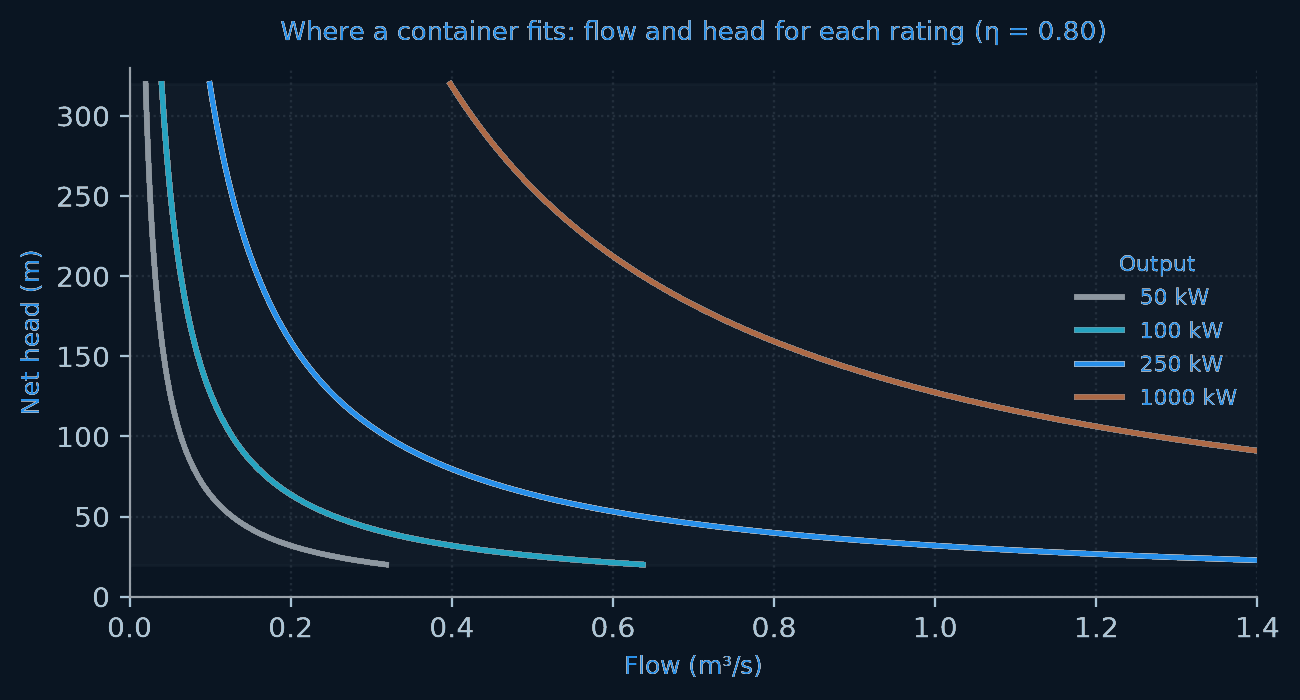
Output is P = ρgQHη, with water-to-wire efficiency estimated at 0.80. Low-head sites need a different machine entirely.
| Net head | Flow | Flow (US) | Output | Turbine |
|---|---|---|---|---|
| 30 m | 0.21 m³/s | ~3,300 gpm | 49 kW | Crossflow / Turgo |
| 100 m | 0.064 m³/s | ~1,010 gpm | 50 kW | Pelton / Turgo |
| 150 m | 0.085 m³/s | ~1,350 gpm | 100 kW | Pelton |
| 50 m | 0.64 m³/s | ~10,100 gpm | 251 kW | Francis / Turgo |
| 200 m | 0.16 m³/s | ~2,540 gpm | 251 kW | Pelton |
Head net of penstock friction; design for under 10% loss (estimate).
50–300 m preferred. Below 30 m the economics stop working with this machine.
Seasonal streams are the norm on the coast, and dry-season flow governs annual output. A year of gauged data is strongly preferred.
A route that delivers the head you paid for, not the head you measured at the intake.
Sling-loaded or trucked in. Set on a small leveled pad above flood line, and a clear sky view for the uplink.
The one requirement that cannot be engineered around. Every site needs a water right, and permitting is the long pole.
What we sell
These sites are far off-grid. There is no line and no one nearby to sell electricity to, so every kilowatt-hour is turned into compute on site and leaves by satellite.
Two pots, not one
Projects that want the credibility of mining without the arithmetic tend to blur these two numbers together. Keeping them apart is the whole point of HydroBit.
HydroBit mines Bitcoin continuously and holds it. That reserve is the collateral behind Echo coin — the asset that gives the coin something to stand on. It is not paid out as wages, and it was never meant to be.
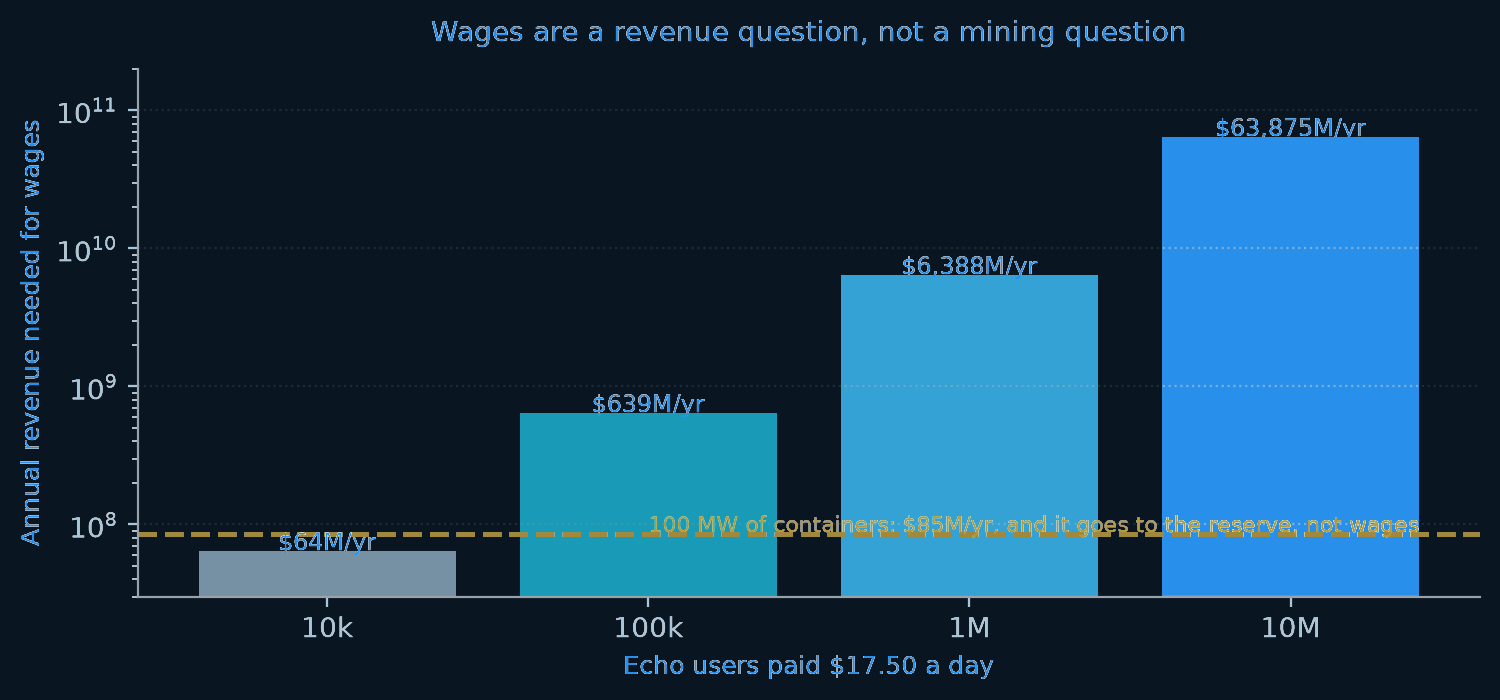
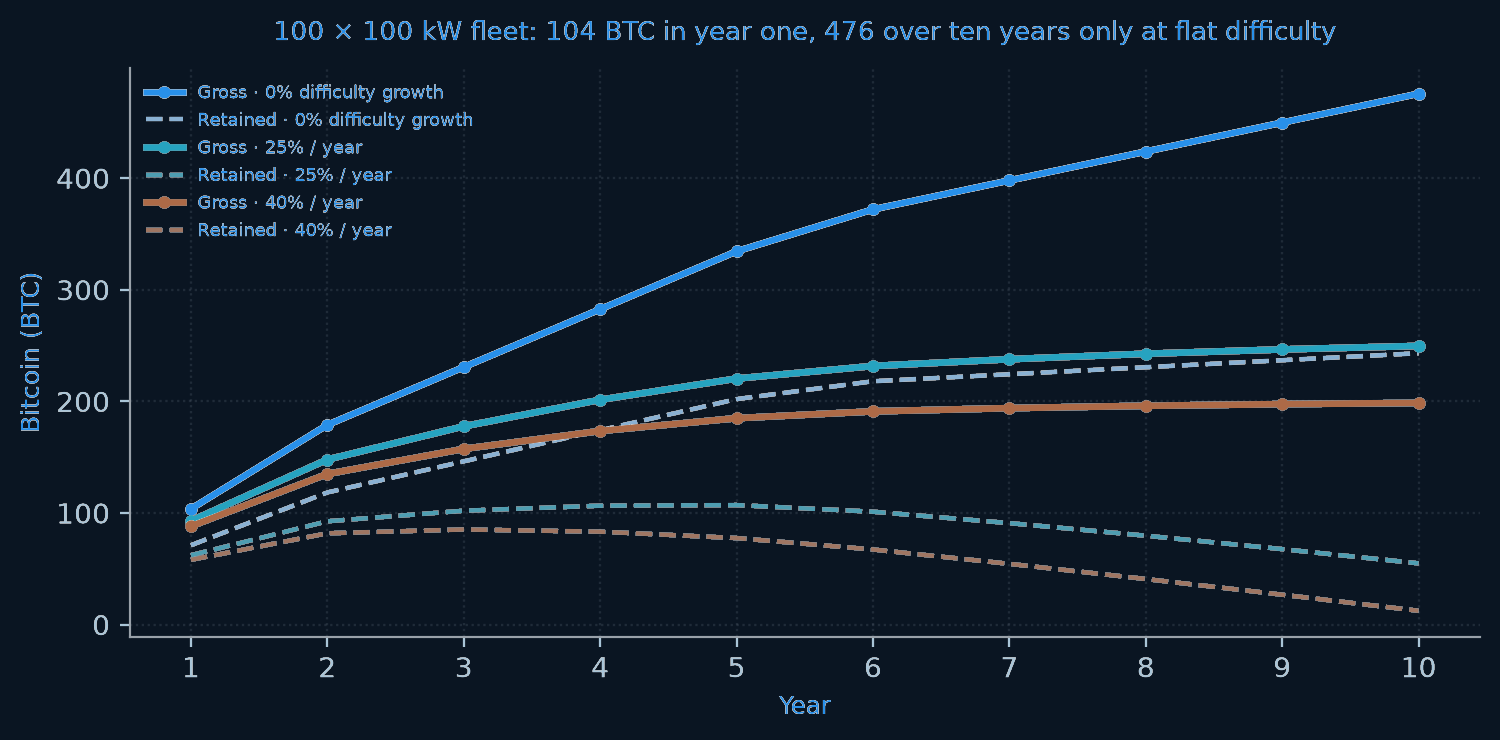
A hundred 100 kW containers mine about 103.7 BTC in year one, worth $8.4 M at today's price. Real money, and none of it is a wage.
Wages come from Echosystem revenue: ads, data sales, marketplace fees, subscriptions and outbound transfer friction. That revenue has to exist before wages can be paid at any daily rate, and the honest way to say it is that the wage scales with what the revenue actually is.
HydroBit does not pay wages. It pays for the infrastructure that makes the wage possible later, if the revenue arrives.
A million users at $17.50 a day needs $6.39 B a year of Echosystem revenue.
Nobody should pretend that arrives in month one. For scale: a 100 MW fleet — a hundred 1 MW containers — mines roughly $85 M a year, and every dollar of it goes to the reserve, not to wages. Mining is not a wage line, and drawing it as one is the mistake this design exists to avoid. Two constraints hold: the same Bitcoin cannot sit in the reserve and be spent as wages, and no amount of mining substitutes for revenue.
Users never see a token balance, a ticker, a chart or a wallet address. The interface shows dollars, and the coin does its work behind that number. A user with $412 inside the Echosystem has $412 of spending power inside it — and leaving with value carries a disclosed outbound transfer friction band of 30–50%, stated in dollars before she moves anything.
Design proposal, not a plan of record. Echo coin has not been minted, is not audited and has not been reviewed by counsel. A coin backed by a reserve, supported by issuer buybacks and described as gaining value from scarcity invites analysis as an investment contract. No coin should be sold, promised or marketed until securities, commodities, money-transmission, tax and consumer-protection lawyers have reviewed the design in each target jurisdiction. Early participants would be buying something with no established value.
Status, plainly
Plan
The near-term milestones are supplier quotes and a detailed design, then one 100 kW pilot built and tested with measured performance published. Sales come before the fleet, because the buyer funds hardware, civil works and permits while HydroBit earns product margin plus monitoring and service fees. A fleet keeps the mining upside but needs roughly $31 M of containers before a single civil work.
Intended hires as funding allows: a licensed hydro or civil engineer for site studies, an electrical engineer for protection and controls, a California water-rights and environmental attorney, a China-based sourcing and quality manager, and a mining operations lead. None has been retained.
The ask
The money covers going to China to build the first 100 kW unit, securing a site, deploying it and commissioning it. Everything after that is a function of whether that unit works.
An opening range, not a fixed term sheet. The figure will be refined once supplier quotes and a site survey are in hand — which is precisely what the round pays for.
No unit sale price is published. Units are sold only to vetted operators, by application, under license. The design is kept confidential because some engineering solutions inside the box are trade secrets.
HydroBit owns its fleet; it builds units for itself first. Units may be sold only to vetted operators under license, by application. There is no public price list, and these units are deliberately expensive at first, or not sold at all.
HydroBit is not yet a legal entity. It is intended to keep some independence while serving as the engine powering Echo — the last social you'll ever need — built with Grok. HydroBit mines and holds BTC as the reserve behind Echo coin. It does not pay wages.
Other ventures that want to model Echo's structure can license the design. That is a separate conversation, by application, and it is not a product you can buy from a page.
A founder, a design, and a documented plan to prove it with one unit. Not revenue, not a customer base, and not a token. The downside case is that the unit does not work, and that case should be priced accordingly.